
Anatoly Guin: Boris, today we admire the portrait of the Mona Lisa. I remember that huge hall packed with people and only one painting on display: the Mona Lisa. Today she will help us. She will be the third participant in our dialogue and will help us dismantle a very common stereotype in recognition theory and among IT researchers who work in this field. Boris, the floor is yours.
Boris Zlotin: I was at the Louvre as well; it was hard to get close to the painting, but I’m persistent, so I managed to approach it. Frankly, I didn’t see anything extraordinary — a good, interesting portrait. For example, I found da Vinci’s Benois Madonna in the Hermitage more compelling. Nevertheless, it’s a beautiful portrait. And you would certainly recognize it even if it were, say, in black and white. It wouldn’t be as beautiful though.
Now for the surprise that once astonished us. We tested image discrimination with PANC™ using random images from the internet. To our surprise, contrary to expectation and intuition, the conditions for optimal machine recognition are not the same as for humans. Let’s return to the Mona Lisa:

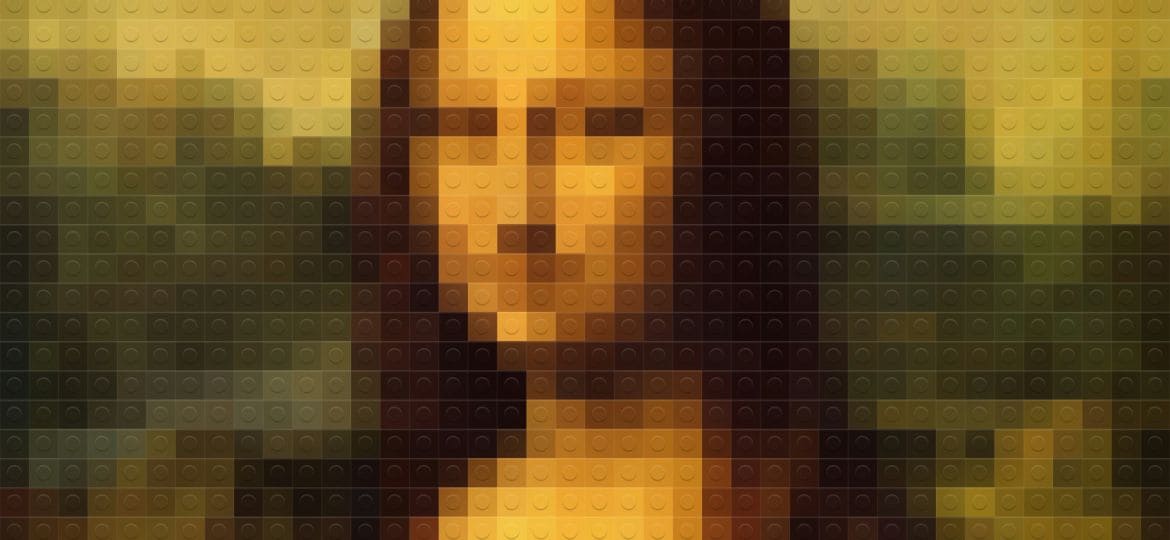
A color image at 1024 × 1024 pixels represents roughly a megabyte of information. Everything is well rendered and detailed. The software discriminates it reasonably well — but not superbly. When we reduce the resolution to only 32 × 32 pixels, so that the number of cells decreases by a factor of 1,000, and replace the usual 256 brightness levels per channel with only ten shades of gray, we obtain a tiny artifact just 4 mm per side. It is practically indistinguishable to the eye. If you enlarge that speck, you get a pixelated image like this.
We cannot recognize the Mona Lisa here, yet the software does. You can reduce further, but recognition then degrades. Human vision is human; machine vision is machine. Render unto Caesar, so to speak. Incidentally, classical convolutional neural networks also don’t compare whole images but their convolutions — complexly formed small copies (in most cases even smaller than ours). However, in our system downscaling and color‑reduction is an instantaneous operation; for the “classics” it is a lengthy and costly procedure.
Sergei Yesenin wrote: “Face to face, one can’t see the face; the great is seen at a distance.” In museums, I always seek the distance from which a painting is best perceived, and only then I step closer, because examining the painting technique is also interesting.
Anatoly Guin: Boris, a thought occurs to me: when you reduce pixel count you get something like a QR code of the painting.
A human–machine hybrid is what we aim for. Remember our previous discussion of a generalized artificial intelligence: it can almost certainly be built, but quite simply it’s not necessary.
Boris Zlotin: No, it will be needed for scientists, for experiments, for that kind of work. What most consumers require is different. We want an assistant that will make us smarter, more erudite, and more creative. I want to state the conclusion plainly: it surprised us that a machine recognizes differently than we do. The stereotype that the sharper the image and the more pixels it contains, the better for machine recognition, turns out to be false.
And that’s excellent, because we can build recognition libraries for the same paintings using such tiny representations that they will operate extraordinarily quickly.
Anatoly Guin: It’s easy to imagine the entire world’s collection of valuable paintings digitized so that the machine instantly finds the required work and then presents it to us in high quality — a two‑tier library. A library of pseudo–QR codes for the machine and a library of high‑quality images for humans.
Boris Zlotin: We recently worked with a group of researchers from a university — I won’t name them — and ran into a problem. We sent them our software for testing. They took 6‑megabyte images and were not very satisfied with recognition, and neither was I. I told them: “Try 32 × 32.” They said: “That’s utter nonsense, rubbish.” They didn’t even bother to check or test — they immediately dismissed it as nonsense… Don’t be stubborn like donkeys, please!
Anatoly Guin: Thank you! Next we’ll discuss which markets can quickly adopt PANC™ and make an assessment of those markets’ sizes.